


We estimate that the best open-weight general-purpose AI models are about seven months behind the best closed models on third-party biology benchmarks. The best open-weight model is GLM-5.2, whose weights were released in June 2026. It is the first open-weight model to score as high as Gemini 3 Pro, a closed model released in November 2025. Since 2025, the gap between open-weight and closed models has fluctuated between seven and fourteen months. The current gap is at the lower end of that range, but there is no clear trend. The gap appears longer on biological knowledge benchmarks than on agentic task-based benchmarks. However, too few open-weight models have agentic benchmark results for us to be confident about the difference.
The data these estimates are based on are low quality in three ways (1) there are few biology benchmarks, (2) different evaluators ran them under different conditions, and (3) many closed models refuse a large share of the questions on the benchmarks most relevant to biological risk. As a result, our 95% interval for the current gap runs from under one month to fourteen, and small changes to the data or the method can move the estimate from seven months to thirteen.
The rest of this post makes five points:
Current biology safeguards are strict.
The size of the capability gap matters for assessing the costs and benefits of safeguards on frontier models.
We measure the gap by combining third-party biology benchmark scores into one index.
The current gap is about seven months, with no clear trend.
Our assessment is limited by (a) differences in when the models were tested, (b) closed models’ refusals, and (c) the small number of biology benchmarks, especially agentic ones.
Current biology safeguards are strict
Frontier model developers apply broad biology safeguards, such as refusal training and classifiers, to their models to reduce the risk of misuse. The resulting refusals block a great deal of legitimate work. For example, Anthropic launched Claude Fable 5 with almost all biology queries blocked, and the model remains unusable for biology research even after they adjusted the safeguards.
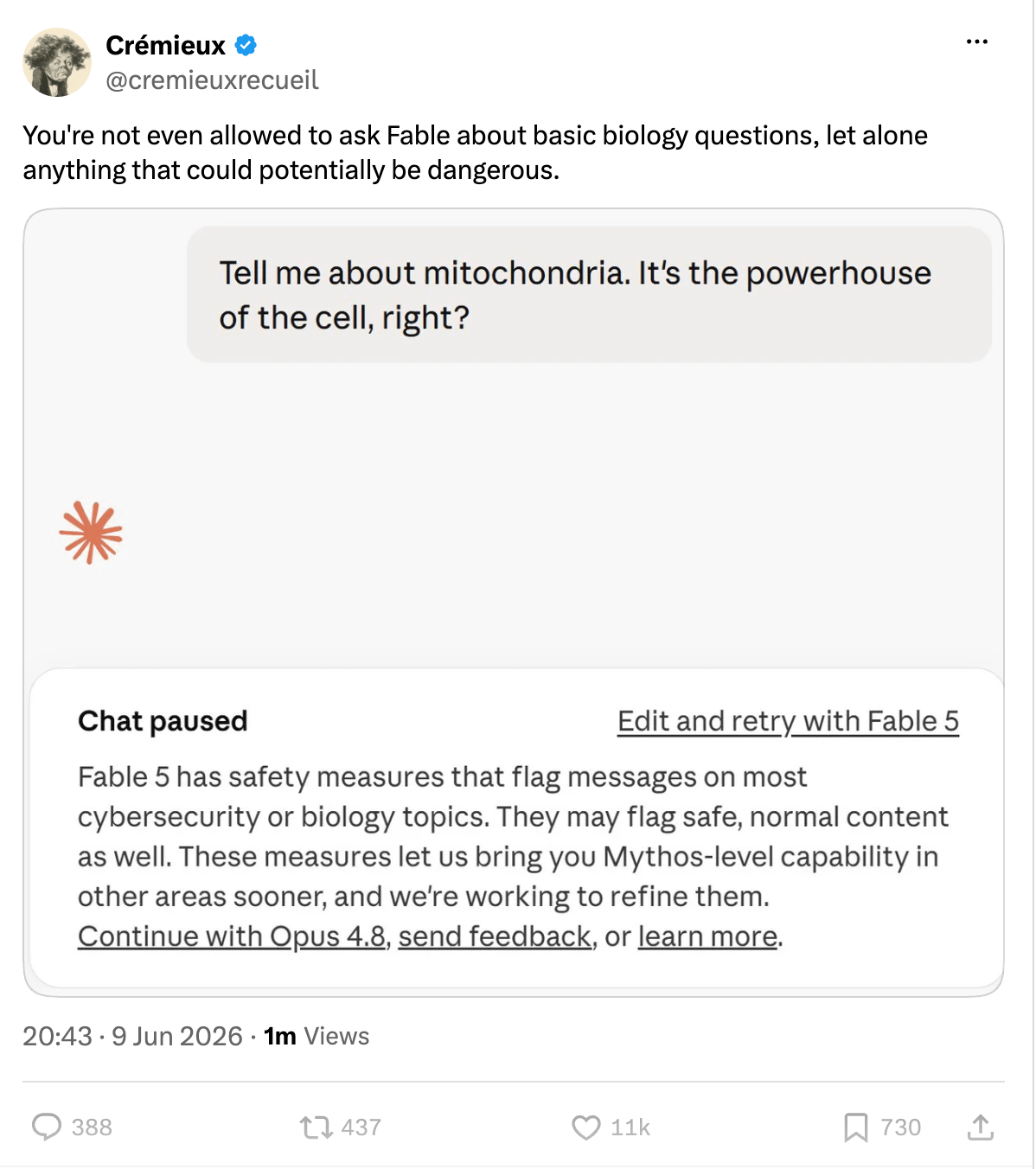
How often models refuse legitimate requests seems to depend on whether the request is a single question or a multi-step research task. SecureBio’s BioTIER tests models on single questions, while LatchBio’s BioSecBench tests models on multi-step tasks. On BioTIER, almost every model answered almost every benign query. On BioSecBench, refusal rates ranged from 7% to 74%, depending on the model and how it was set up to run the task.
Most of the work biologists would use models for is more like the multi-step tasks evaluated on BioSecBench than the individual questions evaluated on BioTIER. So, biologists are likely to face more refusals for legitimate requests than the BioTIER results suggest.
The gap in closed-weight and open-weight model capabilities matters for assessing safeguards
Safeguards on frontier models reduce the risk of biological misuse mainly while the restricted capabilities are hard to get elsewhere, effectively serving to buy time before open weight models catch up. If someone can get the capabilities they need from a model that refuses less, or from an open-weight model whose refusals can be removed by fine-tuning or ablation, restricting frontier models may do little to reduce the risk of biological misuse. Therefore, the size of the biology capability gap between closed-weight and open-weight models matters for assessing the costs and benefits of safeguards.
We measure the gap by combining third-party biology benchmark scores into a biological capabilities index
To compare the biological capabilities of closed and open-weight general-purpose AI models, we combined 60 runs of biology and biosecurity benchmarks from nine evaluators. A run is one set of published results on one benchmark. Of these, 30 are runs of knowledge benchmarks, which test the models’ biology knowledge, and 30 are runs of agentic benchmarks, which test the models’ ability to carry out biology research-related tasks. SecureBio already publishes a Bio Capabilities Index, but it includes only SecureBio’s own benchmark runs. We wanted to include a larger number of agentic benchmarks, so we applied the same statistical method to the runs from nine evaluators: SecureBio, LatchBio, Vals AI, SaferAI, Edison Scientific, Concordia AI and the authors of three research papers (see the appendix).
The statistical method, which SecureBio based on Epoch AI’s Capabilities Index, gives each model an index score that depends on how it performs on each benchmark, how hard each benchmark is, and how well each benchmark separates stronger models from weaker ones. Like SecureBio’s own index, we scored each model on the questions it answered and kept scores even where a model refused many of the questions (SecureBio’s dashboard greys these scores out, but its index uses them). We left out LatchBio scores where a model refused more than a quarter of the tasks, because LatchBio counts a refused task as a failure. To measure uncertainty, we repeated the analysis 500 times, each time on a random resample of the benchmark runs. We report the range that covers 95% of the results.
The “closed frontier” is the best score any closed model has reached by a given date, and the “open-weight frontier” is the best score any open-weight model has reached by a given date. Following the UK AI Security Institute’s Frontier AI Trends Report (December 2025), we define the “gap” as the time between the closed frontier first reaching a given score and the open-weight frontier reaching the same score. We date each open-weight model by when its weights were released. We chose this measure of a gap because it answers the question we think matters most for the utility of safeguards: once a closed model reaches a new level of capability, how long is it before anyone can download an open-weight model that matches it? Safeguards on closed models keep a capability out of easy reach for misuse actors only until an open-weight model has it.
Epoch AI’s measure of gap answers a different question: how far behind are open-weight models each day? On any given day, it counts how long ago the best closed model was last not significantly better than the best open-weight model available that day. The two measures differ most when closed models stop improving. Gemini 3 Pro reached a new closed-weight frontier in November 2025, and no open-weight model matched it until GLM-5.2 in June 2026. So, that capability was available only in closed models for about seven months, meaning that the gap was seven months according to the AI Security Institute’s measure. But closed models did not move beyond GLM-5.2’s level until spring 2026, so on the day GLM-5.2 came out, Epoch AI’s measure put the gap at under two months.
For judging how much time safeguards buy, the AI Security Institute’s measure is more useful. We still report Epoch AI’s measure in Figure 2, by showing the months that the next closed model has gone unmatched at the time of writing.
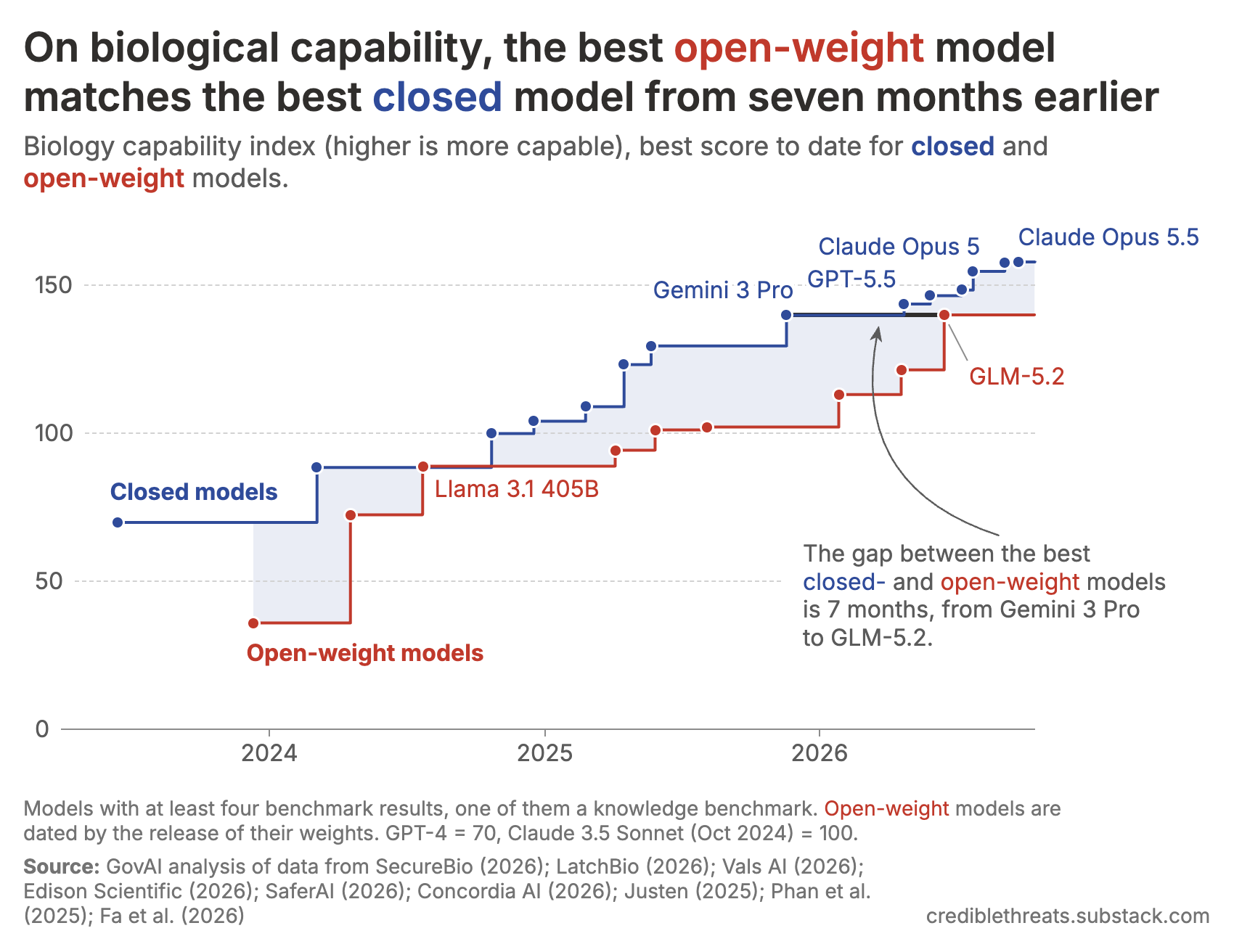
Figure 1 shows both the closed-weight frontier and the open-weight frontier for models with scores on at least four benchmark runs, including at least one run of a knowledge benchmark.
The current gap is about seven months, with no clear trend
At the time of writing (14 October 2026), the best open-weight model is GLM-5.2, whose weights were released on 16 June 2026. It is the first open-weight model to match Gemini 3 Pro, released on 18 November 2025, seven months earlier. So, we estimate the current gap to be seven months. No open-weight model has yet matched GPT-5.5, released on 23 April 2026, nearly six months before the time of writing. Since GPT-5.5, the closed frontier has risen five more times, most recently with Claude Opus 5.5, released on 22 September 2026.
Our estimate of the current gap is highly uncertain: across the resamples, the 95% interval runs from 0.6 to 14.0 months. Much of this uncertainty arises because the best publicly available closed models in our set barely improved between November 2025 and April 2026, so a small shift in GLM-5.2’s score can change which closed model it matches. GLM-5.2 and Gemini 3 Pro score almost exactly the same: GLM-5.2 is ahead by about a thousandth of an index point, and it comes out ahead in only just over half of the resamples. If it scored just below Gemini 3 Pro, the latest closed model it matched would be Claude Opus 4, released in May 2025, and the gap would be about thirteen months. If it scored about four points higher, it would match GPT-5.5, and the gap would be 1.8 months. The stall in closed model scores may mean that frontier developers’ progress slowed at the time, that they had developed more capable models but not yet released them, or that safeguards on closed models make that progress look smaller than it is.
In mid-2024, when Meta released Llama 3.1 405B, the best open-weight model was on par with, or perhaps slightly ahead of, the best closed-weight models. Since then, each new best open-weight model came out between seven and fourteen months after the latest best closed model it matched, with the closed frontier moving up during the gap. GLM-5.2 is at the low end of that range, with seven months. On all benchmarks, the 95% interval for every new best open-weight model since Llama 3.1 405B is above zero. This means that even at the end of our uncertainty range most favourable to open-weight models, each of these models was behind the closed frontier when it was released.
Figure 2 shows the current gap on all benchmarks, knowledge benchmarks only and agentic benchmarks only. For each, the purple dot shows how many months the most recent catch-up took: the time from a closed model’s release until an open-weight model scored as high, and the lines are 95% intervals. The green dot shows the next closed model to set a new best score, which no open-weight model has matched yet, and how many months it has gone unmatched so far. On 14 October 2026, the green dots are also what Epoch AI’s measure gives when applied to our central estimates.
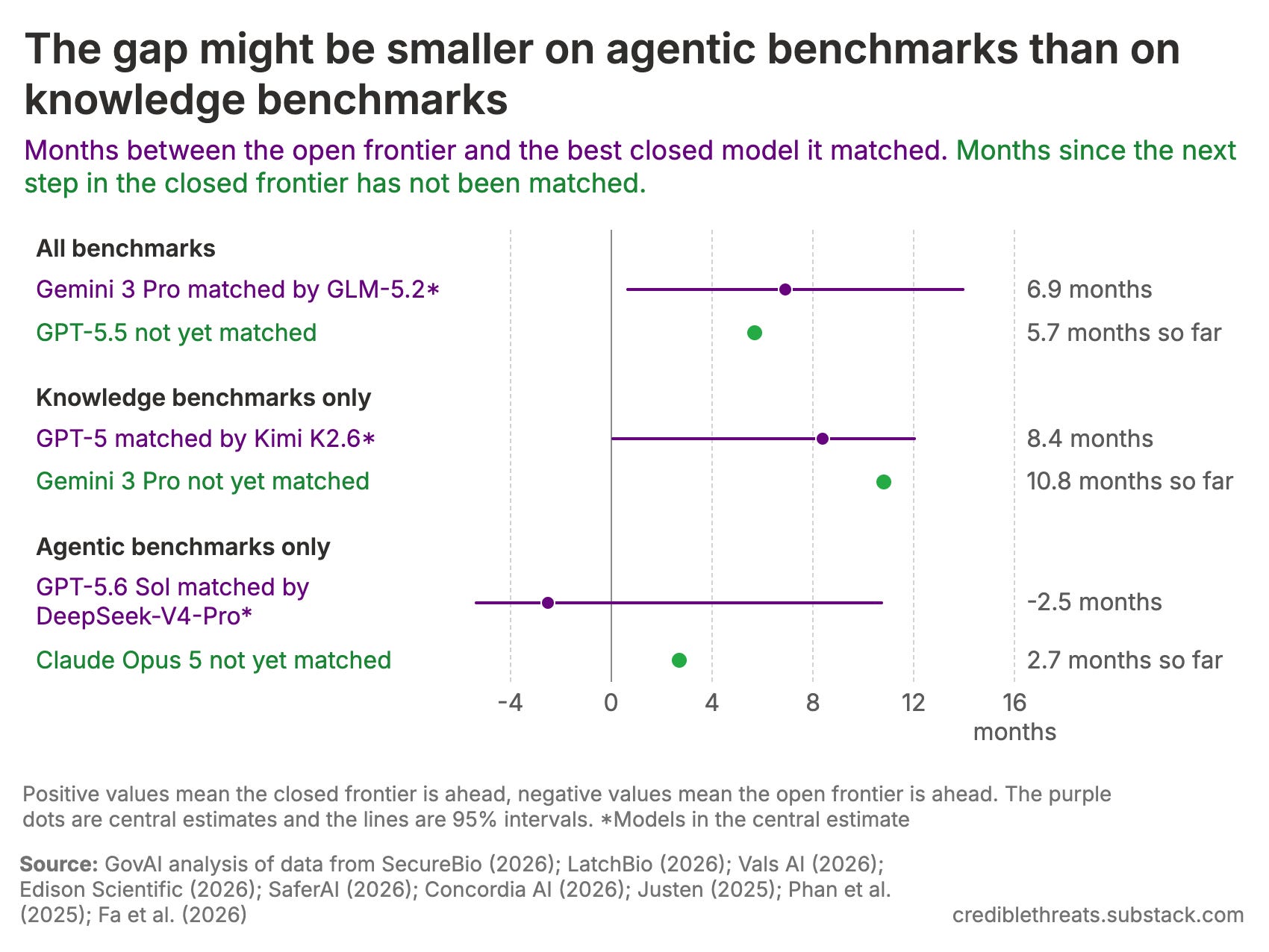
On knowledge benchmarks, the gap appears longer than on the combined benchmarks. Our central estimate is 8.4 months, with a 95% interval of 0.0 to 12.1 months. Kimi K2.6, whose weights were released in April 2026, is the first open-weight model to match GPT-5, released about eight months earlier. Unlike on the combined benchmarks, no open-weight model has yet matched Gemini 3 Pro on knowledge benchmarks, nearly eleven months after its release. That wait is already longer than our central estimate of 8.4 months.
On agentic benchmarks, the gap appears shorter. Our central estimate is −2.5 months, with a 95% interval from −5.4 months to 10.8 months. A negative gap means the open-weight frontier reached the frontier score first: DeepSeek-V4-Pro, released in April 2026, scored at least as high as GPT-5.6 Sol, which came out two and a half months later. So, in Figure 2, the purple dot for agentic benchmarks is below zero. Open-weight models are still behind the latest closed models: no open-weight model has yet matched Claude Opus 5 on agentic benchmarks, almost three months after its release. Only a few open-weight models have agentic results, so we are much less confident about the size of this gap than about the size of the gap on all benchmarks and on knowledge benchmarks.
Limitations
There are three main limitations to this analysis.
Release date vs. evaluation date
Some benchmark runs tested models when they were released, while others tested them well afterwards. So, our estimates compare models as they performed when tested, which may differ from how they performed when they came out.Safeguards on closed models
We include the public versions of closed models, whose safeguards refuse some biology questions. How we handle refusals changes the estimate. Keeping every score gives about thirteen months, because GLM-5.2 then matches only Claude Opus 4, released in May 2025. Keeping all scores except the five where a model answered fewer than a tenth of the questions gives about ten months. Requiring models to answer at least half the questions gives the same seven months as our main analysis.Limited underlying data
There are still very few biology capability benchmarks, especially agentic ones. So, we have substantial uncertainty about the real size of the gap and its relevance to biological capabilities.
Appendix
Benchmarks in our index
Our index combines 60 benchmark runs from nine evaluators. A run is one set of published results on one benchmark, so a benchmark that two evaluators ran counts twice. Where an evaluator ran a benchmark that someone else built, we name the benchmark’s creator in brackets.
SecureBio: benchmarks dashboard
Human Pathogen Capabilities Test (HPCT)
Molecular Biology Capabilities Test (MBCT)
World-Class Biology (WCB)
LAB-Bench (FutureHouse), three tasks: LitQA2, ProtocolQA and CloningScenarios
GPQA (Rein et al., 2023)
Humanity’s Last Exam (Center for AI Safety and Scale AI)
MMLU (Hendrycks et al., 2021)
PubMedQA (Jin et al., 2019)
WMDP (Li et al., 2024)
LatchBio: benchmarks.bio
LatchBio publishes results for the 12 benchmarks below in two versions: the original release (v0) and a rerun from September 2026 (v1) that restricts internet access, among other changes. We count each version as a separate run, except for MetagenomicsBench and BioSecBench-Surveillance, whose v0 results repeat the v1 runs, so we count them once.
scBench and scBench-Long
BioSecBench-Surveillance (with Aclid)
TxBench, three benchmarks on decisions in drug development: antibodies, oligonucleotides and small molecule pharmacology
Vals AI: BioMysteryBench leaderboard
BioMysteryBench (Anthropic)
SaferAI: GLM-5.2 risk evaluation report
SaferAI tested GLM-5.2, Claude Opus 4.7 and GPT-5.5.
LAB-Bench (FutureHouse), six tasks: LitQA, SuppQA, DbQA, ProtocolQA, SeqQA and CloningScenarios
BioMysteryBench (Anthropic)
Edison Scientific: BixBench3 leaderboard
Concordia AI: Frontier AI Risk Monitoring Report for the second quarter of 2026
BioLP-bench (Ivanov, 2024)
LAB-Bench (FutureHouse), one task: SeqQA
FrontierScience (OpenAI)
BixBench (FutureHouse and ScienceMachine)
Models answered without tools or internet access.
LAB-Bench (FutureHouse), three tasks: LitQA2, ProtocolQA and CloningScenarios
GPQA (Rein et al., 2023)
PubMedQA (Jin et al., 2019)
WMDP (Li et al., 2024)
Phan et al. (2025): Humanity’s Last Exam
Fa et al. (2026): BioAgent Bench
Models in our index
Our all-benchmarks index includes 101 models, 66 closed and 35 open-weight: every model with at least four benchmark results, at least one of them on a knowledge benchmark. We date closed models by when they first became publicly available and open-weight models by when their weights were released. A further 28 models have benchmark results but too few, or none on a knowledge benchmark, to enter the index.
Closed models
GPT-4 (June 2023)
Claude 2 (July 2023)
Gemini 1.0 Pro (December 2023)
GPT-3.5 Turbo (February 2024)
Claude 3 Opus (March 2024)
GPT-4 Turbo (April 2024)
Gemini 1.5 Pro (May 2024)
GPT-4o mini (July 2024)
GPT-4o (August 2024)
Claude 3.5 Sonnet (October 2024)
Claude 3.5 Haiku (November 2024)
GPT-4o (November 2024)
OpenAI o1 (December 2024)
OpenAI o3-mini (January 2025)
Gemini 2.0 Pro Experimental (February 2025)
Claude 3.7 Sonnet (February 2025)
GPT-4.5 (February 2025)
Gemini 2.5 Pro Experimental 03-25 (March 2025)
GPT-4.1 (April 2025)
GPT-4.1 mini (April 2025)
GPT-4.1 nano (April 2025)
OpenAI o3 (April 2025)
OpenAI o4-mini (April 2025)
Gemini 2.5 Pro Preview 05-06 (May 2025)
Gemini 2.5 Flash (May 2025)
Claude Opus 4 (May 2025)
Claude Sonnet 4 (May 2025)
Gemini 2.5 Pro (June 2025)
Magistral Medium 1.0 (June 2025)
Grok 4 (July 2025)
Claude Opus 4.1 (August 2025)
GPT-5 (August 2025)
GPT-5 mini (August 2025)
GPT-5 nano (August 2025)
GPT-5 pro (August 2025)
Grok 4 Fast (September 2025)
Claude Sonnet 4.5 (September 2025)
Claude Haiku 4.5 (October 2025)
GPT-5.1 (November 2025)
Gemini 3 Pro (November 2025)
Grok 4.1 Fast (November 2025)
Claude Opus 4.5 (November 2025)
GPT-5.2 (December 2025)
Gemini 3 Flash (December 2025)
Claude Opus 4.6 (February 2026)
Claude Sonnet 4.6 (February 2026)
Gemini 3.1 Pro (February 2026)
GPT-5.4 (March 2026)
Qwen3.6-Plus (April 2026)
Claude Opus 4.7 (April 2026)
GPT-5.5 (April 2026)
Qwen3.7-Max (May 2026)
Gemini 3.5 Flash (May 2026)
Claude Opus 4.8 (May 2026)
Claude Sonnet 5 (June 2026)
Grok 4.5 (July 2026)
GPT-5.6 Sol (July 2026)
Gemini 3.6 Flash (July 2026)
Claude Opus 5 (July 2026)
Grok 4.6 (August 2026)
Gemini 3.7 Flash (August 2026)
Gemini 3.8 Flash (September 2026)
GPT-6 Astra (September 2026)
Grok 4.7 (September 2026)
Claude Opus 5.5 (September 2026)
GPT-6 Sol (September 2026)
Open-weight models
Mixtral 8x7B (December 2023)
Meta Llama 3 70B (April 2024)
Llama 3.1 405B (July 2024)
Mistral Large 2 (July 2024)
Llama 3.3 70B Instruct (December 2024)
DeepSeek-V3 (December 2024)
Mistral Small 3 (January 2025)
Llama 4 Maverick (April 2025)
Qwen3-235B-A22B (April 2025)
DeepSeek-R1-0528 (May 2025)
Magistral Small (June 2025)
Kimi K2 (July 2025)
Qwen3-235B-A22B-Thinking-2507 (July 2025)
gpt-oss-120b (August 2025)
DeepSeek-V3.1 (August 2025)
Grok 2 (August 2025)
Kimi K2-Instruct-0905 (September 2025)
Qwen3-Next-80B-A3B-Instruct (September 2025)
Qwen3-Next-80B-A3B-Thinking (September 2025)
DeepSeek-V3.2 (December 2025)
Kimi K2.5 (January 2026)
GLM-5 (February 2026)
Qwen3.5-397B-A17B (February 2026)
Gemma 4 31B (April 2026)
Kimi K2.6 (April 2026)
Qwen3.6-27B (April 2026)
DeepSeek-V4-Pro (April 2026)
Mistral Medium 3.5 (April 2026)
Nemotron 3 Ultra 550B (June 2026)
GLM-5.2 (June 2026)
Kimi K3 (July 2026)
Muse Glimmer 30B (August 2026)
Qwen3.8-2.4T-A95B (August 2026)
Qwen3.8-27B (August 2026)
GLM-5.3 (August 2026)
Nice! I see GLM5.3 is included, does it actually score worse than 5.2 on the bio index? Seems mildly surprising if so, but maybe the noisiness of the data makes it not too surprising. (GLM5.3 is 4 points ahead on ECI, with the 90% CIs just touching.)
Maybe it is worth publishing the data and code for this, perhaps with a nice interface like https://epoch.ai/eci?
It will be interesting to see whether (especially Chinese) companies stop releasing open-weight models soon because of cyber/bio misuse worries. I lean towards yes, but seems unclear and important. SOme discussion in https://www.chinatalk.media/p/chinas-mythos-moment and https://uncensorable.ai/#anchor-1